Each of two players operates a food truck and must allocate 30 minutes between preparing burgers and preparing fries. The only item a player sells is a Combo consisting of one burger and one serving of fries. Therefore her payoff is equal to whichever is smaller: the number of fries, or the number of burgers brought on the truck. By default, one player
has an absolute advantage in the production of both, but the players differ in opportunity cost.
When you allow trade, each player can propose trading burgers for fries. Because players differ in opportunity cost, there are mutually beneficial trades. When satisfied with her trades, but before the end of the round, each player must finalize production.
Learning Objective 1: Opportunity Cost Differences Lead to Gains from Trade
Trade allows an uncoupling of production and consumption. As long as there is a difference in opportunity cost, then there are trades that simultaneously benefit both players. Importantly, this holds even if one has an absolute advantage in both
goods.
Learning Objective 2: The Linear Production Model
With total inputs fixed, the linear production model highlights the concept of opportunity cost, i.e., how many fries could I have made with the time I now devote to producing an extra burger. This allows clear distinction between having an absolute
advantage (requiring less time to produce a burger) and comparative advantage (needing to give up fewer fries in order to produce a burger).
Brief Instructions
With interrelated production, consumption, and trade decisions, comparative advantage presents a complex environment. We recommend the following protocol:
For the first game, set Rounds to 1 and make sure Allow Trade is unchecked. This will give your students an opportunity to familiarize themselves with dividing labor between the two tasks and motivate the no-trade baseline. Most will quickly find
the payoff-maximizing allocation, so setting an overall game Duration of 2 minutes will be sufficient.
You now want to introduce trade. Create a new game, setting Rounds to 1 and making sure Allow Trade is checked.
As learning is important in this game, you likely want to run another one-round game with trade. To increase learning, you will want to shuffle groups. After finishing the first one-round game with trade, click Replay and
Random. Both partners and roles will be randomly assigned.
Key Treatment Variations
The main learning objectives are supported by the default parameters. You can, however, change each type's Production Possibilities Frontier (PPF). If you do, remember that the greater the difference in opportunity cost (fries per minute/burgers per
minute), the easier it will be for your students to find mutually beneficial trades. Likewise, if one type's opportunity cost is less than 1 and the other's is greater than 1, then 1 for 1 trades (which are focal) will be mutually beneficial.
Results
For the primary learning objective, you want to show that trade allowed individuals (in at least some pairs) to consume outside of their PPF. In addition, you may want to show that this happened because individuals at least partially specialized in the task in which they have a comparative advantage.
Figure 1: Go To Menu
Use the Go To menu (Figure 1) to view a different round of a multi-round game. If you used one of the Replay options, you can compare outcomes of this game with one of these linked games using the
Compare button.
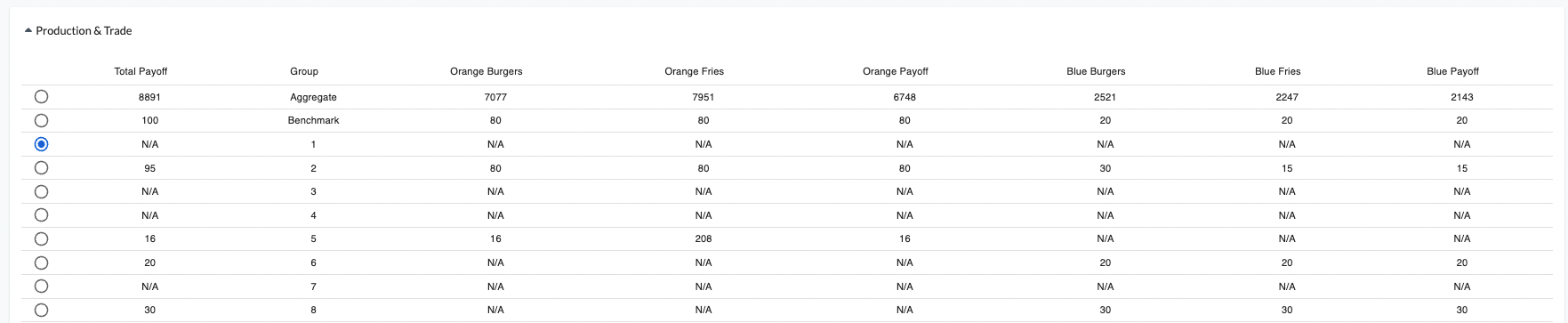
Figure 2: Summary Table with Radio Buttons per Group
Use the individual groups in the data table to view group-specific data (Figure 2). The top row presents the aggregate across all groups. The second to the top row shows the no-trade
optimum: number of burgers and fries, and payoff, for each player. Subsequent rows show the same information, after taking into account trade, for each group. From this table, you can easily see which groups found mutually beneficial trades
by comparing each player's payoff to the no-trade optimum. You can graph a particular group's choices by marking that group's radio button.
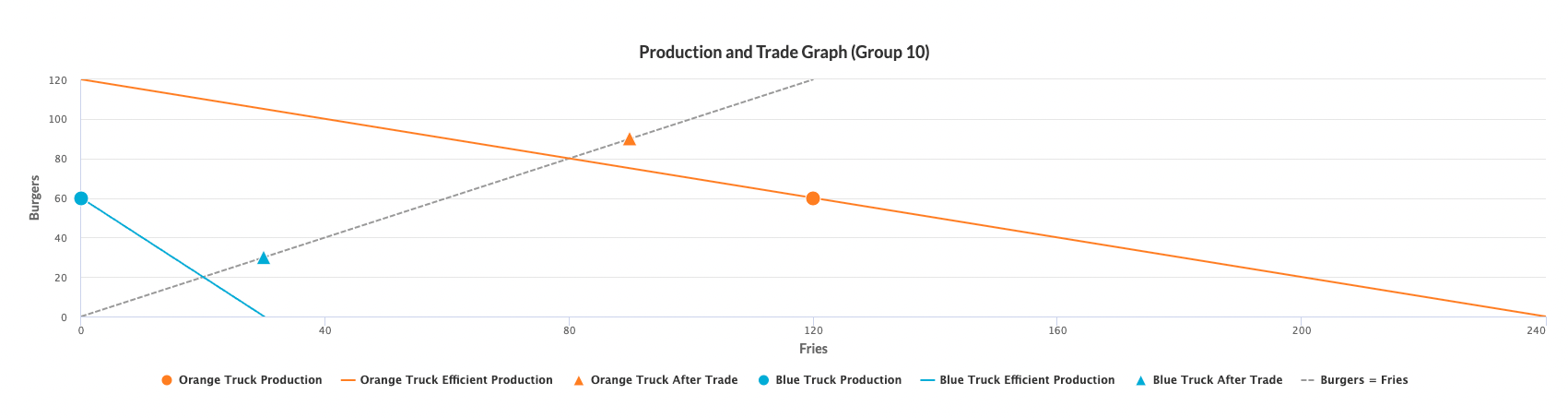
Figure 3: Group-level Production and Consumption Decisions
This view defaults to the first group and the Production & Trade graph shown in Figure 3. The graph shows each type's PPF and on it plots each student's final production choice in a group. With trade enabled, you will also see each student's consumption after trade and you should see each type at least somewhat specializing in its comparative advantage.
Note: Because students allocate time in whole minutes, a student's outcome (accounting for trade) may only be close to, and not exactly on, the depicted 45-degree line where the number of burgers equals the number of fries.
Figure 4: Aggregate Production Decisions
Figure 5: Aggregate Consumption Decisions
When selecting the Radio Button of the top row, Figure 4 and Figure 5 display. They show each type's PPF and plot each student's final production and consumption choice (i.e., the number of burgers and fries the student brings on the truck) across all groups. The dot size increases in the number of observations. With trade enabled, you should see each type at least somewhat specializing in its comparative advantage and you will see individuals consuming outside of their PPF.
Robot Play
The robot makes offers which are sampled from the range of possible offers based on two criteria:
The offer ratio must be within the relative opportunity costs (serving as lower and upper bound).
Both partners need to be made strictly better off in terms of combos gained (consumption).
Additionally, the robot waits 20 seconds before making the first offer and stops trading 25 seconds before the end or when no more mutually beneficial trades are possible.
Note to Instructors
Because of the logic of the robot strategy, it will not propose any trades if the round duration is set to less than 45 seconds.