Each bidder has a randomly determined private value for one unit of a good. The auction price ticks down at regular intervals, and a bidder can claim a unit at any time. The auction ends when all units are claimed: everyone who claimed an item receives
one and pays the price at which the final unit was claimed.
Learning Objective 1: Descending Clock Auctions
Demonstrates the workings of a descending clock auction.
A player’s equilibrium bidding strategy is to claim an item at a price beneath her value. This strategy balances the benefit of letting the price tick down (paying a lower price) with the cost (someone else claiming the item).
Learning Objective 3: Relation to Other Types of Auctions
Play this game in conjunction with the ascending clock auction (or the private value second-price sealed-bid auction) to show the difference in optimal bidding strategy. You can also show that the optimal bidding strategy in the descending clock
auction is equivalent to that of the (private-value) first-price sealed bid auction.
Brief Instructions
By default, the auction price starts at $120 (Start Price), and decreases by $5 (Price Decrement) every 2 seconds (Decrement Duration). Each bidder values
one unit, and this value is drawn from the uniform distribution from Lowest Bidder Value=$10 to Highest Bidder Value=$100. Each bidder draws a new value for each new period if multiple
periods are specified (Periods > 1).
Make sure that it is common knowledge that bidder values are drawn from the uniform distribution. In this case, assuming bidders are risk-neutral, the Bayesian Nash Equilibrium Bid Function is [(N-1)/N]*Buyer Value, where N=Group Size.
With default parameters, the Bayesian Nash Equilibrium Bid Function is 5/6*Buyer Value.
Key Treatment Variations
Multiple Units
With Units > 1, multiple units are on auction, but each bidder still values one unit. The auction ends when all Units are claimed. Each winner pays the price at which the last unit
was claimed.
Results
The results highlight the Bayesian Nash Equilibrium and show how close your students were to equilibrium play. Use the Go To: menu to switch between periods.
Figure 1: Outcome Summary Table
For each period, there is a table summarizing each group’s performance (Figure 1). With Units = N, the first columns display the sum of the N-highest item values (Optimal Surplus) and the sum of the winners’
item values (Surplus).1 The final column shows seller Revenue (final price × N). Check the radio button to reveal a figure summarizing a group’s bidding.
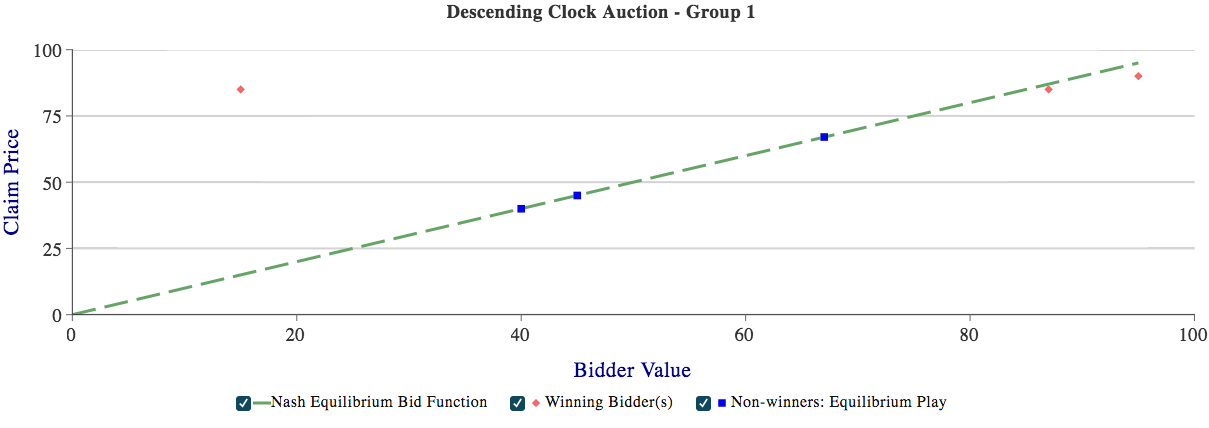
Figure 2: Participant Bids and Values
In Figure 2 we plot each player in the group with a marker with Bidder Value on the horizontal axis and Claim Price on the vertical and includes a line plotting the bid function. To see whether players follow the Nash bid function we use
one marker type for those claiming an item (red diamons according to the legend), and a different marker for those who do not claim (blue squares) an item. In equilibrium, those who claimed should be those with the highest values.
Robot Play
Our robot (i.e., an automated player) strategy is the following:
Robots claim the item and subsequently win the auction as soon as the price is less than their value.
Footnotes
1. Surplus calculations assume the items have no value to the seller. ↩