
Tulip Diseases
Gary W. Moorman, Professor of Plant Pathology
| Disease | Symptoms | Pathogen/Cause | Management |
|---|---|---|---|
| BASAL ROT | Large spots on bulbs are dark brown. White or pink fungal growth forms on the bulbs. Flowers from infected bulbs are deformed. Foliage dies prematurely. | Fusarium oxysporum f. sp. tulipae | Do not plant bulbs that have white or pink fungus on them. Purchase and plant fungicide-treated bulbs. |
| FIRE | Leaves may fail to emerge or may be stunted or deformed. The shoots may curl to one side. Dead spots are surrounded by dark green. Spots turn white or yellow and have small black granules (sclerotia) in them. | Botrytis tulipae | Purchase fungicide-treated bulbs. Apply iprodione, thiophanate methyl, or chlorothalonil to protect healthy plants. |
| PYTHIUM ROOT ROT | Bulbs have soft, gray spots with brown borders at the base of the bulb. Shoots fail to emerge. | Pythium | Plant in chemically or steam-pasteurized potting mix. Discard infected plants. |
| STEM AND BULB NEMATODE | Bulbs have gray to brown patches that feel spongy. Bulbs feel lighter than normal at planting and the interior of the bulb is mealy in texture. | Ditylenchus dipsaci | Purchase and plant hot water treated bulbs. Discard infected bulbs. |
| VIRUSES | Leaves may be mottled, have yellow flecks or stripes. Flower color may break or flowers may be distorted. | Many viruses are known including tulip breaking, tobacco necrosis, tobacco rattle, tobacco mosaic, and cucumber mosaic virus. | Discard infected plants. Purchase virus-free plants. |
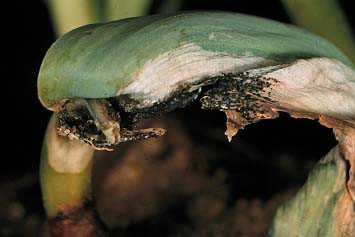
Fire (Botrytis).
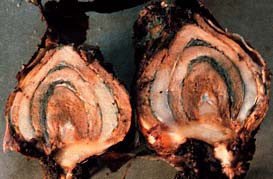
Blue mold.
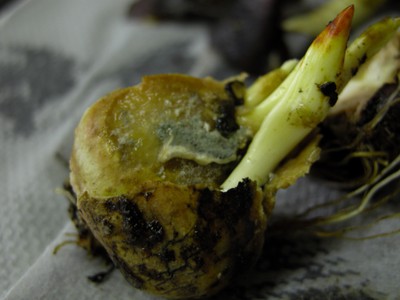
Blue mold.
Active Ingredients and Trade Names of the Chemicals
| FRAC Group no. | Risk Level | Class | Active ingredient | REI Restricted Entry Level | Trade names (EPA Reg. no.) |
|---|---|---|---|---|---|
| 1 | 3 | Benzimidazole | thiophanate methyl | 12 | 3336 (1001-69), OHP 6672 (51036-329-59807), Fungo Flo (51036-329-59807), Systec 1998 (48234-12) |
| 2 | 3 | Dicarboximide | iprodione | 12 | Chipco 26GT (100-1138), Chipco 26019 (264-481), Iprodione (51036-361), Sextant (51036-361-59807) |
| M | 1 | Chloronitrile | chlorothalonil | 48 | Daconil (50534-9), Exotherm Termil (70-223) |
| 12 | Echo (60063-7), PathGuard (60063-7-499), Concorde (72167-24-1812), Pegasus (72167-24-1812) |
Fungicides and Fungicide Resistance Management - Certain fungicides, usually systemic fungicides, are said to be 'at risk' to the development of resistance if they are used repeatedly. See the Risk Level in the above table (1 = low risk; 3 = high risk). The Fungicide Resistance Action Committee has developed a numbering system in which chemicals with the same FRAC Group number have the same mode of action (See http://www.frac.info/frac/index.htm ). It is recommended that chemicals at high risk be used sparingly and in rotation or mixed with chemicals with different modes of actions (different FRAC number).
DISCLAIMER
Notice: The user of this information assumes all risks for personal injury or property damage.
Warning! Pesticides are poisonous. Read and follow all directions and safety precautions on labels. Handle carefully and store in original labeled containers out of the reach of children, pets, and livestock. Dispose of empty containers right away, in a safe manner and place. Do not contaminate forage, streams or ponds.
Issued in furtherance of Cooperative Extension work, Acts of Congress, May 8 and June 30, 1914, in cooperation with the U. S. Department of Penn State College of Agricultural Sciences research and extension programs are funded in part by Pennsylvania counties, the Commonwealth of Pennsylvania, and the U.S. Department of Agriculture.
Visit Penn State Extension on the web at extension.psu.edu.
Where trade names appear, no discrimination is intended, and no endorsement by Penn State Cooperative Extension is implied.
This publication is available in alternative media on request.
The Pennsylvania State University is committed to the policy that all persons shall have equal access to programs, facilities, admission, and employment without regard to personal characteristics not related to ability, performance, or qualifications as determined by University policy or by state or federal authorities. It is the policy of the University to maintain an academic and work environment free of discrimination, including harassment. The Pennsylvania State University prohibits discrimination and harassment against any person because of age, ancestry, color, disability or handicap, national origin, race, religious creed, sex, sexual orientation, gender identity, or veteran status. Discrimination or harassment against faculty, staff, or students will not be tolerated at The Pennsylvania State University. Direct all inquiries regarding the nondiscrimination policy to the Affirmative Action Director, The Pennsylvania State University, 328 Boucke Building, University Park, PA 16802-5901; Tel 814-865-4700/V, 814-863-1150/TTY.
