 Send a letter to the Editor
 Most Read
 Most E-mailed
 E-mail Article
 Print Article

Hollywood Hills, CA�While many people prefer to use environmentally friendly products in their homes, for environmental architect Jim Chuda and his wife Nancy, this was less of a personal preference than a mission. Co-founders of the Children�s Health Environmental Coalition (CHEC), the Chudas knew �green� design would be a top priority for them, so they went in search of a designer who could meet their environmental sensibilities � without sacrificing high style and functionality.
The Chudas found their answer in Troy Adams Design in West Hollywood, CA, a firm that�s well known for its �FusionDesign� philosophy. FusionDesign combines European technology and style, American functionality and Asian symbiosis with nature, employing a mix of cultures, materials, design, textures and patterns. The philosophy blended well with the couple�s own environmental focus � so much so, in fact, that the Chudas� home ended up on the �healthy house map� as an example of a totally green home, thanks to its use of sustainable and renewable resources.
Designing with Fusion
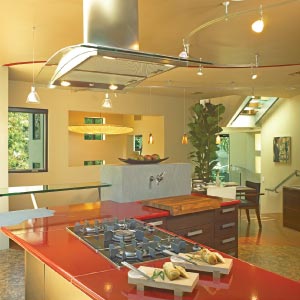
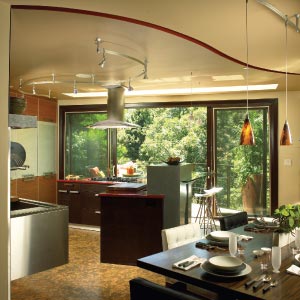
Adams incorporated his FusionDesign concept when designing the kitchen and dining areas. The objective was to use an adjoining kitchen/dining room space to create a living, socializing area, with room for all of the appliances and furnishings, while taking advantage of an adjoining outdoor deck. An L-shaped island and open floor plan allows for interaction between people in the kitchen and the dining area and the deck.
When choosing the colors and the mood of the kitchen, Adams took a slightly different approach by starting with the floor. �Normally when we start with a palette, we look at the largest expansive material, and what we want that material to be,� he explains. �In this case, it was a cork floor. It was chosen because this was a green project, and we were using materials that were environmentally friendly � no fluorocarbons and no formaldehyde.�
Adams wanted to use a different but complementary material for the dining area, to provide a visual separation between the small spaces. �We used a serpentine shape in the floor, and made the kitchen cork and the dining area bamboo,� he explains. �Then we stained the bamboo to match the cork. That was the start of the material palette.�
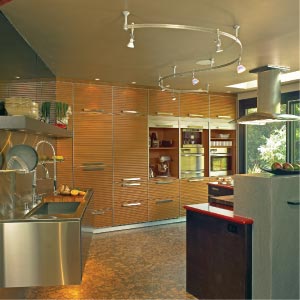
From there, Adams pulled colors from the cork and bamboo to guide the choice of cabinet shades. Custom designed cabinets from cherry, wenge and Macassar Ebony were manufactured in Germany, because of the country�s stricter standards for materials and products, notes Adams. Cherry was used along the back wall appliance garage, and wenge around the island.
Macassar Ebony was chosen to highlight the suspended sink area, �because it has a dark, rich, Asian look to the wood,� Adams reports. �The two-tone look in the center of the wood pulls the color of the bamboo floor and the cherry wood cabinetry.�
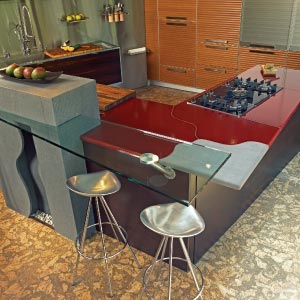
The prep sink area features a trough sink from Kohler, and two faucets from Dornbracht. A brushed stainless steel countertop is highlighted by a sliding wood cutting board in end grain teak by Spekva.
Stainless steel, aluminum and frosted glass highlight the cabinetry, providing breaks and adding to the overall contemporary feel.
The countertops also provide a modern yet earthy aesthetic, with multiple materials setting the tone.