
Review
Five times the Naim
Model: Naim Audio NAIT 5 integrated amp
Price: RM5,400
Distributed by ABSOLUTE HI-FI SDN BHD (Tel: 03-704-8788 / 8433), 25 Jalan SS24/11, Taman Megah, 47301 Petaling Jaya, Selangor.
IT was a few weeks ago that I waltzed into one of the local music outlets, on the lookout for a certain album. I’d just seen the music video the day before on MTV.
It was then that I came to the realisation that I had indeed heard that song played on the airwaves some time ago but it never appealed to me until I saw the video. This made me realise the importance of a well-produced music video.
Well, I managed to find the album. Excited over my new purchase, I rushed home to listen to it. As soon as I got home though, it hit me that my hi-fi was in shambles – speaker cables were lying all over the place and nothing had been hooked up.
It was then that I remembered the Naim Audio NAIT 5 integrated amplifier that had been passed to me for review sometime back. Goody, I thought – no better time to hook it up.
FeaturesThe Series 5 range of components is Naim’s attempt at improving a plain looking black and green box to something a little more aesthetically pleasing. Curves and sexy luminescent green backlights have been introduced in this series comprising the CD5 CD player, the NAT 05 FM Tuner, the NAC 112 preamplifier and NAP 150 power amplifier, and finally the NAIT 5 integrated amplifier.
The entire Series 5 range benefits from a newly designed low-vibration cast/machined aluminium chassis; the styling of which mimics Naim’s top-of-the-line NAP 500 power amplifier. Couch potatoes will be glad to hear that the NAIT 5 amp comes with a remote control, though power hungry fans will be disappointed with the meagre 30-watts per channel offered by the amp. Nevertheless, power is often not a factor when it comes to audio quality, as many valve enthusiasts would no doubt agree.
Input selection is via green backlit buttons offering six inputs – CD, AV, Tuner, Tape, Aux 1 and Aux 2. The fascia is of a fairly simple yet elegant design, with the input selection buttons lined neatly in a row beside a large resistor ladder volume control. Flip the amp around and you see odd looking input connectors unlike the usual RCA inputs. These are DIN inputs in which DIN to RCA interconnect cables are required. For the speakers, the Naim does not provide binding posts. Instead, recessed 4mm banana plug sockets are provided, so no bare wire cables or mere spades.
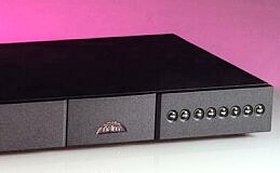 Naim NAIT 5 |
The amp also provides outputs to allow connection to the Flatcap power supply or the NAP 150 power amp. The remote control provided is called the Narcom 2, which can be used with the company’s current range of CD players, tuners, preamps and integrated amps.
PerformanceMy house recently underwent some minor renovation, so most of my hi-fi was stored away in the storeroom, safe from dust and fumes. My dad’s system, however, was left exposed; having suffered severe toxic poisoning, I figured I might as well use it. A Creek passive preamp and Musical Fidelity XA50 monoblocks provided comparative amplification, while speakers were a pair of Mission 753 cabled with Audioquest Midnight. Source was a Marantz CD67 CD player, and interconnects by Monster Cable.
The album I had been going on about earlier was none other than In Blue by my favourite Irish band, The Corrs. I’d seen the music video for One Night and simply loved it; in fact, it was while searching for the duet version, that I settled for In Blue instead. Needless to say, I couldn’t wait to listen to the Irish plying through the Brit.
I loaded the disc and fired up the Naim right away. A good feature of the amp is that upon powering up it automatically engages the mute button. The main reason for this is to avoid the sudden burst of current that occurs when the amp is switched on, often resulting in damaged speakers, especially if the volume knob is cranked up high. Many, if not most, people forget to turn down the volume as they power up amps so this feature is certainly helpful.
Back to the music – within a few seconds, the muting circuit got out of the way and I cranked up the volume slowly. Initially, Andrea Corr’s vocals were a tad harsh; I decided to leave the amp running at mid-volume to run it in. After a full day or so I returned to find that things had smoothened out – vocals were fluid, with no hint of harshness.
It was now time for the real test. First up was track eight, One Night. Corr’s vocals were crystal clear and flowed with a fluidity only found in high-end systems. Acoustic guitar was sharp yet refined and background ambience full and rich. Moving back to track one, Breathless, a more upbeat number, the Naim really shone through. Drums and percussion were excellently portrayed – sharp and punchy, yet never harsh. Vocals were transparent and soaked in detail whilst imaging was pin sharp. You could imagine Andrea moving from left to right of the stage while the background vocalists retained their stature. Bass guitar was subtle yet well defined as it echoed in the atmosphere. Excellent stuff.
The Special Edition version of the album comes with a second CD with the acoustic version of some of the songs listed in the first disc. Here, Corr’s angelic voice really shines through. You can hear every breath as the microphone picks it up, with acoustic guitar in the background. The strings are plucked beautifully as vibrations dance around the mike. There is often a hollowness portrayed with acoustic recordings and this is no exception – the Naim is able to capture the ambience and atmosphere of the recording with realistic accuracy as vocals are thrust forward in fluid motion.
Next up was a mixture of classical recordings from the likes of Steven Isserlis and the late Jacqueline du Pre. The cello swooped from highs to lows, with a dark and mellow groan as the bow glided gently across the strings – you can almost visualise the emotion on the cellist’s face as the despair and gloom is laid bare. The accompanying violin remains intact in the background, waltzing gingerly with the cello hand in hand to a climactic finale.
This amp has a rightness about its sound that is rare indeed, drawing the listener into the music.
For example, the Naim reproduces the vocals of Diana Krall’s All For You with beautiful solidity and plenty of detail, keeping the highly distinctive character of Krall’s voice intact.
Despite its richness and intensity, a distinct hollowness is echoed in the background, engulfing the music in a thick enveloping fog. To some, this hollowness could be mistaken for a lack of richness – this certain quality of the amp requires proper matching to get it right.
Partner it with bright components and you’re certainly in for a ride of splashy percussion and lack of deep rich substance.
The Naim truly excels in certain areas. Play Stravinsky’s soaring Firebird Suite for instance, and there's fine soundstaging and surprisingly vivid dynamics, though dynamic range is limited.
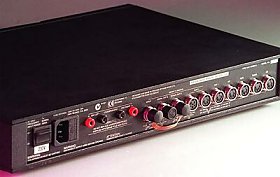 WATCH YOUR BACK … the Naim NAIT 5 from the rear. See the DIN connectors? |
A lovely, open midrange and sure-footed approach to rhythm compensates here. With something a little harder hitting, the amp does far better than you’d expect. There’s plenty of snap to transients, bass remains tight and tuneful, and as the mix gains complexity, the Naim stays in control. That said, the Naim is never going to satisfy headbangers.
Having run through a mix of music, the Naim NAIT 5 reigned supreme. Given a wider choice of speakers and CD players, it could have produced even better results. Despite the fact that the system in use was fairly bright, the Naim did pretty well. Yes, hollow at times but that all boils down to improper ancillary matching. Match it right and you have a winner.
ConclusionThis is clearly a fine amp. When coupled with fairly bright electronics it can result in it being upfront and a tad hollow, though. Matching plays an important role here in order to tame the brightness of this amp. All in all, matched with appropriate equipment, the Naim NAIT 5 will thrill.
Pros: Excellent detail and control throughout; bass is sufficiently deep whilst imaging is pin-sharp accurate.
Cons: A tad hollow at times, bordering on treble harshness; requires proper component matching to give its best performance.



 RSS
RSS